
Guided implant surgery starts with a 3D CT scan of the jaw and a digital scan of the mouth. In dedicated software every implant is planned — position, angle, depth and diameter — relative to the bone, the nerves, the sinus and the future tooth. From the plan a clear surgical guide is printed, which sits in the mouth during placement and steers the drill and the implant exactly to the planned spot.
Medically reviewed by the network's medical management · updated:
The advantages
Precision
An average deviation of about a millimetre from the plan — which is why the safety margin from the nerve and the sinus is built into the plan itself. Especially important near the nerve in the lower jaw and in the aesthetic front zone.
Minimally invasive
In most cases the gum need not be opened; placement is through a small opening. Fewer stitches, less swelling.
Short
The decisions were made in planning, not in the chair. The placement itself takes 20–40 minutes per implant.
Planned from the end
The implant is where the crown needs it — not where it was convenient to drill. That determines the aesthetics.
Enables immediate loading
A provisional bridge can be prepared in advance from the same plan and fitted the same day.
You see it first
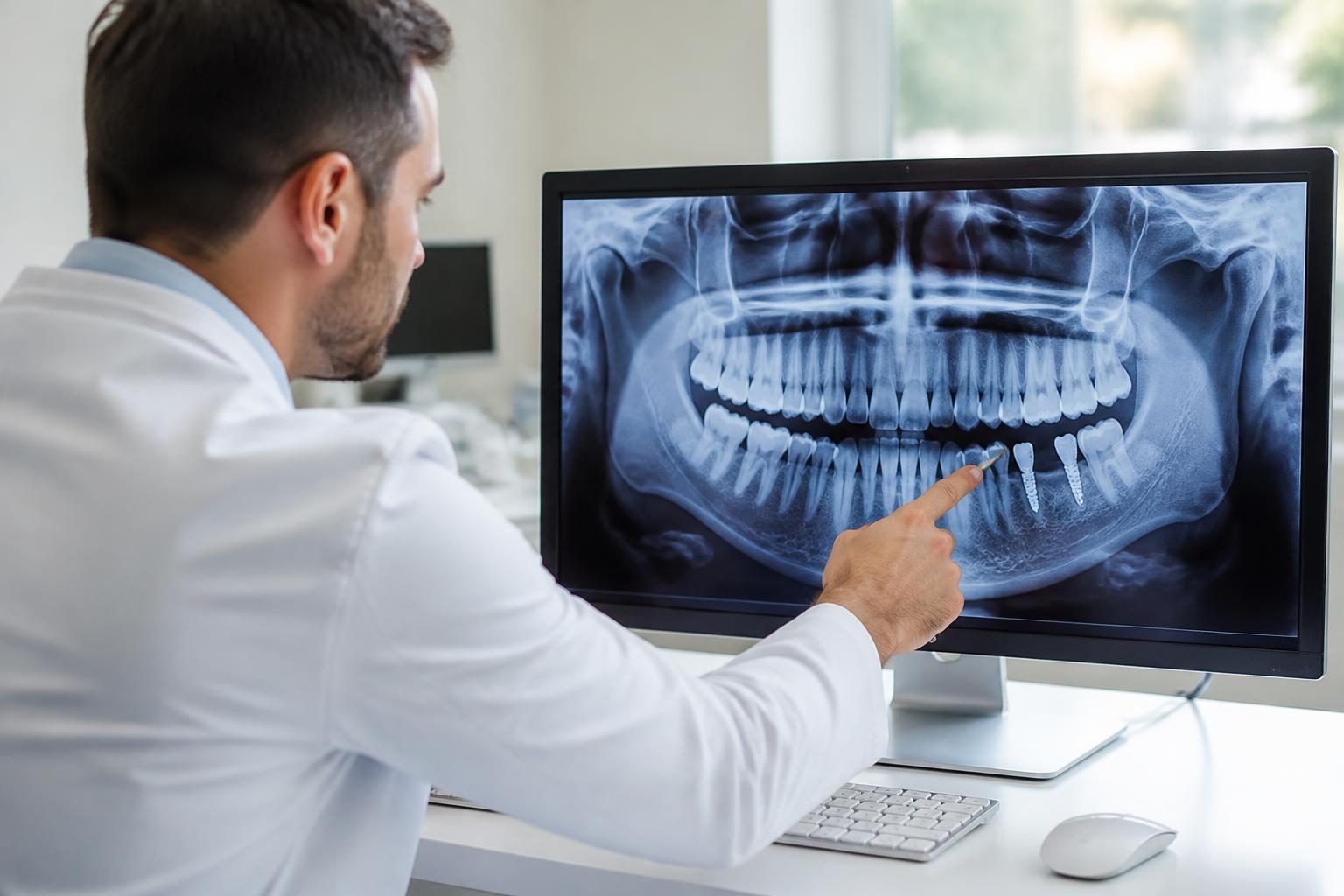
You see the plan on screen — where each implant goes, at what angle — before anything happens in your mouth.
Who it suits
Anyone who needs an implant — single, several or a full jaw. Where it matters most: near the nerve in the lower jaw, in narrow bone, for a front tooth that shows when you smile, and when immediate loading is planned with a bridge prepared in advance.
The process, briefly
CT and intraoral scan merge into one model — bone and soft tissue. On that model the implant and the crown are planned together, and you see it on screen. The guide is printed with a sleeve for every implant. On the day the guide is seated, drilling and implant pass through it, and that is it. A provisional crown if needed; the permanent one after healing.
Frequently asked questions
How long does an implant last?
An implant that has fused well and is looked after — decades, sometimes a lifetime. The implant itself is a titanium screw inside the bone, and there’s nothing in it to wear out. What does get replaced is what sits on it: the crown may be replaced after 10–20 years, a screw that loosens is tightened at a check-up, and on an implant overdenture the nylon inserts in the attachments are changed every year or two. The things that shorten an implant’s life are known and hold no surprises: smoking, poor hygiene, untreated gum disease, uncontrolled diabetes, and an implant placed at the wrong angle — the last is solved by guided planning. What’s down to you: daily cleaning under the crown or bridge, and an exam and professional clean once a year. Keep those two up and the implant generally forgets it’s an implant.
What is a surgical guide?
A clear device, a bit like a night guard, printed from the digital plan and seated on the gum or on the remaining teeth during surgery. Inside it there’s a metal sleeve for each implant, and the drill and the implant pass through it — so the position, angle and depth planned on the CT reach the mouth without guesswork. In practice that means three things: the dentist doesn’t need to open the gum wide to see the bone, so the incision is small and there are usually no stitches; the implant sits where the crown needs it, not where it was convenient to place it; and the surgery is shorter, because the decisions were made beforehand. The guide is made individually for each patient, and you see the plan it’s based on, on screen, before surgery.
Can an implant be placed right after an extraction?
In suitable cases, yes — we extract and place the implant at the same visit, and it goes into the socket of the tooth that came out. That saves a whole operation and months of waiting, and keeps the bone and gum where they were. Two conditions: a clean socket with no active infection, and enough bone beyond the tip of the root for the implant to grip firmly. The second we see on the CT beforehand; the first we confirm finally at the moment of extraction, when we can see the socket. If there’s pus or the bone has been destroyed, we clean it out, let it heal for two or three months, and place the implant afterwards — sometimes filling the socket with bone material (socket preservation) so the bone doesn’t resorb in the meantime. For a front tooth, when conditions are good, we fit a provisional crown the same day so the gum shapes itself around it.
Which implants do you use?
Titanium implants from established manufacturers — the kind with many years of clinical documentation and spare parts you can still get a decade from now, in Israel and abroad. The exact model, diameter and length of each implant are chosen for the case at the planning stage, not by package. Why it matters to you and not just to us: a screw or abutment that needs replacing in 12 years, with another dentist in another city, has to be something that can be ordered. That’s why at the end of treatment you get an implant passport — with the manufacturer, model, dimensions and position of every implant. If you have a question about a particular manufacturer, ask at the consultation; we’ll name it. What we don’t do: an undocumented implant just because it’s cheap.
Do I need an MRI or a special CT?
CT — yes, MRI — no. The scan you need is a dental CT (CBCT): low radiation, a few minutes standing or sitting at an imaging centre, and you get a disc or a link. We give you the referral, and we read the result at the consultation on screen, together with you. The clinics themselves don’t take CT scans. If you have a CT of the jaws from the past year, bring it — there’s a good chance we won’t need a new one. An ordinary panoramic X-ray isn’t enough: it shows height roughly, doesn’t show width, and doesn’t show exactly where the nerve or the sinus is. People are told “you’ve no bone” on the strength of a panoramic — and on the strength of a CT they find out they have. Best to have the scan a few days before the consultation, so it’s with us at the meeting.
Can you feel the implant?
No. It has no nerves and it’s inside the bone — like the root of a tooth, which you don’t feel either. What you do feel at first is the crown: it’s slightly different from the tooth that was there, maybe half a millimetre higher or a touch wider, and the tongue finds it. After two weeks you forget that too. One thing, though: an implant doesn’t warn you when you bite something too hard the way a natural tooth does, which is why we say not to bite ice or seeds. Our patients can’t say which tooth is the implant without looking.
Can I have an MRI with implants?
Yes. Dental implants are titanium, and titanium isn’t magnetic — it doesn’t move, doesn’t heat up and isn’t pulled by the MRI’s field. Tell the technician before the scan that you have dental implants (it’s a question on their form anyway), they note it, and that’s it. What can happen: a small distortion in the image around the mouth if the scan is of the head — the radiologist knows how to allow for it. A removable implant overdenture comes out for the scan, like any denture. You won’t set off airport security either. If the doctor ordering the scan wants to know exactly what’s in your mouth — the implant passport you received answers that.
Why not a bridge on the teeth instead of an implant?
Because for a bridge, two healthy teeth on either side of the gap are ground down to hold it, and in ten years you have three problems instead of one — the ground teeth weaken, sometimes crack or need root canal treatment, and the bridge itself lasts 10–15 years on average. An implant doesn’t touch the neighbours, and it preserves the bone in the area because it keeps passing load into it; under a bridge the bone keeps resorbing. Cleaning too: an implant is cleaned like a tooth, a bridge needs special floss underneath. When a bridge still makes sense: when the neighbouring teeth need crowns anyway, when there’s no bone and you don’t want to build it, or when a medical condition rules out surgery. It’s a short treatment — two or three weeks — and it has its place. Just not as the default.
What is an “implant passport”?
A card you get at the end of treatment with the manufacturer, model, diameter and length of every implant, and its position in the mouth — sometimes with the serial-number stickers that come in the implant’s packaging too. Why it matters: an implant is a screw with an internal thread specific to the manufacturer and model. If in 15 years another dentist in another city needs to replace a screw, an abutment or a crown, they have to know what to order — and without the card it’s guesswork, sometimes with an X-ray, sometimes without success. The card also answers the questions of a doctor ordering an MRI. Keep it with your important documents, and photograph it onto your phone. If you lose it — the details are also stored in your file across the network, so you can ask for a copy. Your family dentist gets a copy of it in the summary letter.
Want to know if immediate loading is right for you?
A first consultation at any network clinic includes an exam, a reading of your scan and an explanation of the options — no obligation.